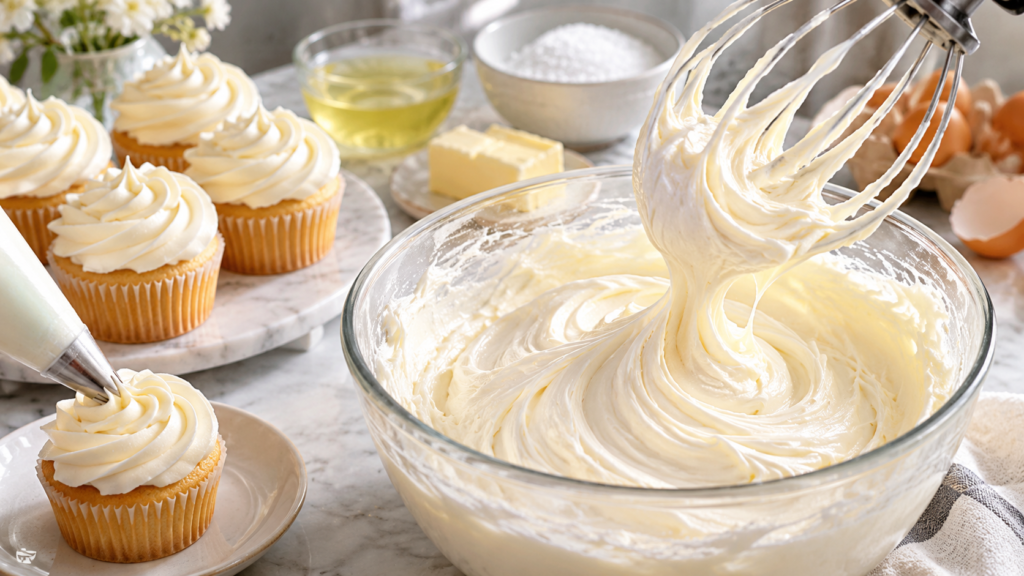
This buttercream frosting recipe with egg whites makes a smooth, fluffy, and creamy frosting using egg whites, sugar, butter, and vanilla. Also known as Swiss meringue buttercream, it is less sweet than traditional American buttercream and perfect for cakes, cupcakes, and piping decorations. The secret is whipping heated egg whites into a glossy meringue before adding butter.
Unlike regular buttercream made with powdered sugar, this recipe creates a silky texture with a rich, balanced flavor. You can also customize it with chocolate, coffee, or other flavors.
What Is Buttercream Frosting With Egg Whites?

Buttercream frosting with egg whites is a creamy frosting made by combining whipped egg whites, dissolved sugar, and softened butter. The most common version is called Swiss meringue buttercream.
The egg whites create a light, airy base, while butter adds richness and a smooth consistency. Because the sugar dissolves before whipping, the finished frosting does not have the grainy texture sometimes found in American buttercream.
Swiss meringue buttercream works particularly well for layer cakes, birthday cakes, cupcakes, and decorative piping.
What Ingredients Do You Need for Egg White Buttercream?

You only need five basic ingredients to make a simple buttercream frosting recipe with egg whites.
Ingredients
| Ingredient | Quantity |
|---|---|
| Large egg whites | 4 (about 120 g) |
| Granulated sugar | 1¼ cups (250 g) |
| Unsalted butter | 1½ cups (340 g) |
| Vanilla extract | 2 teaspoons |
| Fine salt | ⅛ teaspoon |
How Do You Make Buttercream Frosting With Egg Whites?

Making Swiss meringue buttercream involves heating egg whites with sugar, whipping them until fluffy, and gradually incorporating softened butter.
Step 1: Heat the Egg Whites and Sugar
Add egg whites and granulated sugar to a clean, heatproof bowl.
Place the bowl over a saucepan of gently simmering water, ensuring the bottom does not touch the water.
Whisk continuously until the sugar dissolves and the mixture reaches 160°F (71°C) on a food thermometer. This usually takes 5–10 minutes.
Step 2: Whip the Egg Whites
Transfer the heated mixture to a stand mixer fitted with a whisk attachment.
Beat on medium-high speed for approximately 10–15 minutes until the meringue becomes thick, glossy, and forms stiff peaks.
The mixing bowl should cool to around room temperature before adding butter.
Step 3: Add the Butter
Reduce the mixer speed to medium and gradually add softened butter, one tablespoon at a time.
Continue beating until all the butter is incorporated.
The frosting may briefly appear curdled or separated. Keep mixing because this often resolves naturally as the ingredients emulsify.
Step 4: Add Vanilla and Salt
Add vanilla extract and salt. Continue mixing until the frosting becomes smooth, creamy, and fluffy.
For an extra-smooth finish, switch to a paddle attachment and mix on low speed for a few minutes to reduce air bubbles.
Step 5: Frost Your Cake or Cupcakes
Spread the finished buttercream over completely cooled cakes or transfer it to a piping bag.
Use it immediately for the best decorating consistency. If the frosting becomes too soft, refrigerate briefly and rewhip before decorating.
How Do You Make Chocolate Buttercream Frosting With Egg Whites?

Chocolate buttercream frosting with egg whites is made by incorporating melted, cooled chocolate into prepared Swiss meringue buttercream.
For the recipe above, start with 100 g (3½ oz) dark chocolate.
Melt the chocolate gently and let it cool until no longer warm but still fluid. Gradually add it to the prepared buttercream while mixing on low speed.
Continue beating until the frosting becomes smooth and evenly chocolate-colored.
Avoid adding hot chocolate because it can melt the butter and make the frosting too soft.
This variation is particularly delicious on chocolate cakes, cupcakes, and layered desserts.
Can You Make Icing With Egg White and Sugar Only?
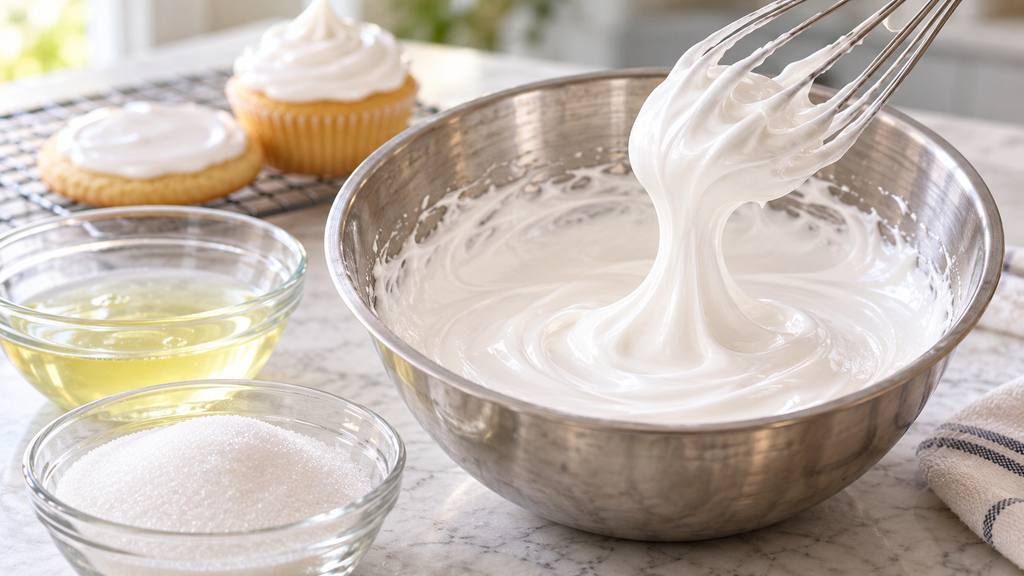
Yes. You can make a simple icing using only egg whites and sugar, although it is technically meringue frosting rather than buttercream because it contains no butter.
For a small batch, combine 2 large egg whites with 120 g granulated sugar in a heatproof bowl.
Heat over simmering water while whisking continuously until the sugar dissolves and the mixture reaches 160°F (71°C).
Transfer to a mixer and beat until thick, glossy peaks form.
The result is a light, marshmallow-like icing suitable for topping cakes and cupcakes. Unlike buttercream, it is best used soon after preparation.
What Is Old-Fashioned Egg White Frosting?

Old-fashioned egg white frosting, commonly called seven-minute frosting, is a fluffy icing traditionally made by beating egg whites and sugar over simmering water.
Some versions also include water, corn syrup, vanilla, or cream of tartar.
Unlike Swiss meringue buttercream, seven-minute frosting does not contain butter. Its texture is lighter and more marshmallow-like.
It is commonly used for coconut cakes, angel food cakes, and traditional homemade layer cakes.
Can You Make Egg White Frosting Without Cream of Tartar?

Yes. You can make Swiss meringue buttercream without cream of tartar because heating egg whites with sugar helps create a stable meringue.
Cream of tartar is sometimes added to whipped egg whites to improve foam stability, but it is not essential for this recipe.
For the best results, use a clean, grease-free mixing bowl, avoid getting egg yolks into the whites, dissolve the sugar completely, and whip until glossy stiff peaks form.
Is Swiss Meringue Buttercream Better Than Regular Buttercream?
Swiss meringue buttercream is smoother and generally less sweet than traditional American buttercream. However, American buttercream is quicker and easier to prepare.
| Feature | Swiss Meringue Buttercream | American Buttercream |
|---|---|---|
| Egg whites | Yes | No |
| Sugar | Granulated | Powdered |
| Texture | Silky and smooth | Thick and fluffy |
| Sweetness | Less sweet | Usually sweeter |
| Preparation | Moderate | Easy |
| Best use | Smooth cake finishes and piping | Everyday cakes and cupcakes |
Swiss meringue buttercream is a good choice when you want a refined finish, while American buttercream works well when convenience matters most.
Why Is My Egg White Buttercream Runny or Curdled?
Egg white buttercream usually becomes runny, grainy, or curdled because of temperature problems or incomplete mixing.
| Problem | Possible Cause | Solution |
|---|---|---|
| Runny frosting | Mixture too warm | Refrigerate 15–20 minutes and rewhip |
| Curdled frosting | Butter too cold | Gently warm the bowl and continue mixing |
| Grainy texture | Sugar not dissolved | Dissolve sugar fully during heating |
| Not fluffy | Meringue insufficiently whipped | Whip until stiff peaks form |
| Too many air bubbles | Excess air from mixing | Mix slowly with a paddle attachment |
If your buttercream appears curdled, do not discard it immediately. Adjusting its temperature and continuing to mix will often restore its smooth consistency.
Can You Use Carton Egg Whites for Buttercream?
Yes. Pasteurized carton egg whites can be used for Swiss meringue buttercream, although whipping performance varies between products.
Some packaged egg whites do not form stiff peaks as easily as freshly separated eggs.
Choose a product labeled suitable for whipping or meringue and measure 120 g of liquid egg whites for this recipe.
How Do You Store Egg White Buttercream Frosting?
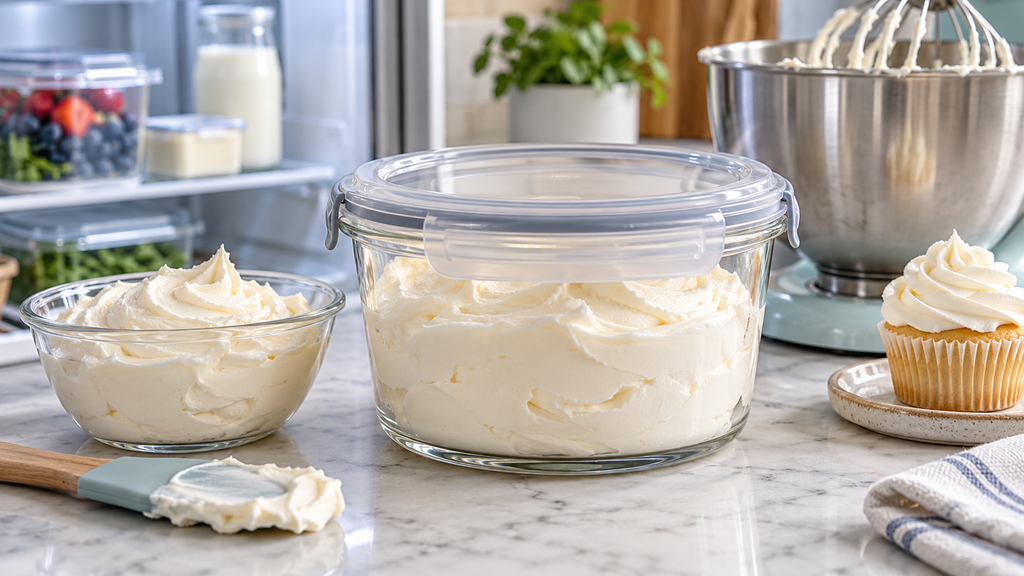
Store Swiss meringue buttercream in an airtight container in the refrigerator for up to one week. It can also be frozen for up to six months when properly sealed.
Before using refrigerated buttercream, allow it to soften until pliable, then beat until smooth.
For frozen frosting, thaw it overnight in the refrigerator before bringing it toward a workable temperature and rewhipping.
Because the frosting contains eggs and dairy, avoid leaving it unrefrigerated for extended periods, especially in warm weather.
What Are the Best Tips for Perfect Egg White Buttercream?
A smooth and stable egg white buttercream depends on accurate measurements, proper whipping, and careful temperature control.
- Use fresh egg whites or carton whites suitable for whipping.
- Keep mixing bowls completely free of grease.
- Heat the egg whites and sugar to 160°F (71°C).
- Allow the meringue to cool before adding butter.
- Add cool, softened butter gradually.
- Continue mixing if the frosting briefly looks curdled.
- Use a kitchen thermometer for consistent results.
- Avoid decorating warm cakes because the buttercream can melt.
Following these techniques helps create frosting that is creamy, spreadable, and suitable for piping.

Buttercream Frosting Recipe With Egg Whites
Ingredients
Method
- Step 1 — Heat the Egg Whites and Sugar
- Combine egg whites and sugar in a clean, heatproof bowl. Place over gently simmering water without touching the water. Whisk continuously for 5–10 minutes until the sugar dissolves and the mixture reaches 160°F (71°C).
- Step 2 — Whip the Meringue
- Transfer the mixture to a stand mixer fitted with a whisk attachment. Beat on medium-high speed for 10–15 minutes until thick, glossy stiff peaks form and the bowl cools to approximately room temperature.
- Step 3 — Add the Butter
- Reduce mixer speed to medium. Add softened butter gradually, one tablespoon at a time. Continue mixing until fully incorporated and creamy, even if the frosting temporarily looks curdled.
- Step 4 — Add Vanilla and Salt
- Mix in vanilla extract and salt until smooth and fluffy. For a silky finish, switch to the paddle attachment and mix on low speed for a few minutes.
- Step 5 — Frost and Decorate
- Spread the buttercream over completely cooled cakes or pipe onto cupcakes. If too soft, refrigerate briefly and rewhip before using.
Notes
-
Chocolate variation: Add 100 g melted and cooled dark chocolate to the finished buttercream.
-
Runny frosting: Refrigerate for 15–20 minutes and rewhip.
-
Curdled frosting: Gently warm the mixing bowl and continue beating.
-
Storage: Refrigerate in an airtight container for up to 1 week or freeze for up to 6 months.
-
Important: Heat egg whites and sugar to 160°F (71°C), and allow the meringue to cool before adding butter.
Frequently Asked Questions
Can you make buttercream frosting with egg whites instead of whole eggs?
Yes. Swiss meringue buttercream uses egg whites rather than whole eggs. The whites are heated with sugar, whipped into meringue, and combined with softened butter.
What is the easiest buttercream frosting with egg whites?
Swiss meringue buttercream is a practical option because the egg whites and sugar are heated together before whipping, without preparing a separate hot sugar syrup.
Does egg white buttercream taste like eggs?
Properly prepared Swiss meringue buttercream has a rich, buttery, vanilla flavor rather than a strong egg taste.
Can you make buttercream frosting with egg whites and butter only?
No. Traditional Swiss meringue buttercream also needs sugar to stabilize the meringue and provide sweetness.
Can I make egg white buttercream without powdered sugar?
Yes. Swiss meringue buttercream uses granulated sugar dissolved into heated egg whites, so powdered sugar is unnecessary.
Is egg white buttercream safe to eat?
Swiss meringue buttercream is prepared by heating egg whites and sugar to 160°F (71°C). Use a food thermometer and follow safe egg-handling and storage practices.
Can I make buttercream frosting with egg whites ahead of time?
Yes. Prepare it in advance, store it in an airtight container in the refrigerator, and rewhip after softening to restore its smooth texture.
Is egg white buttercream good for cupcakes?
Yes. Its silky consistency makes it suitable for cupcake swirls, decorative borders, and cake frosting.

I’m Tahira Ramzan, an experienced recipe creator and the founder of EggWhiteRecipes.com. I specialize in simple, practical egg white recipes made with everyday ingredients. My goal is to share easy-to-follow recipes, helpful cooking tips, and reliable methods that make home cooking easier and more enjoyable.