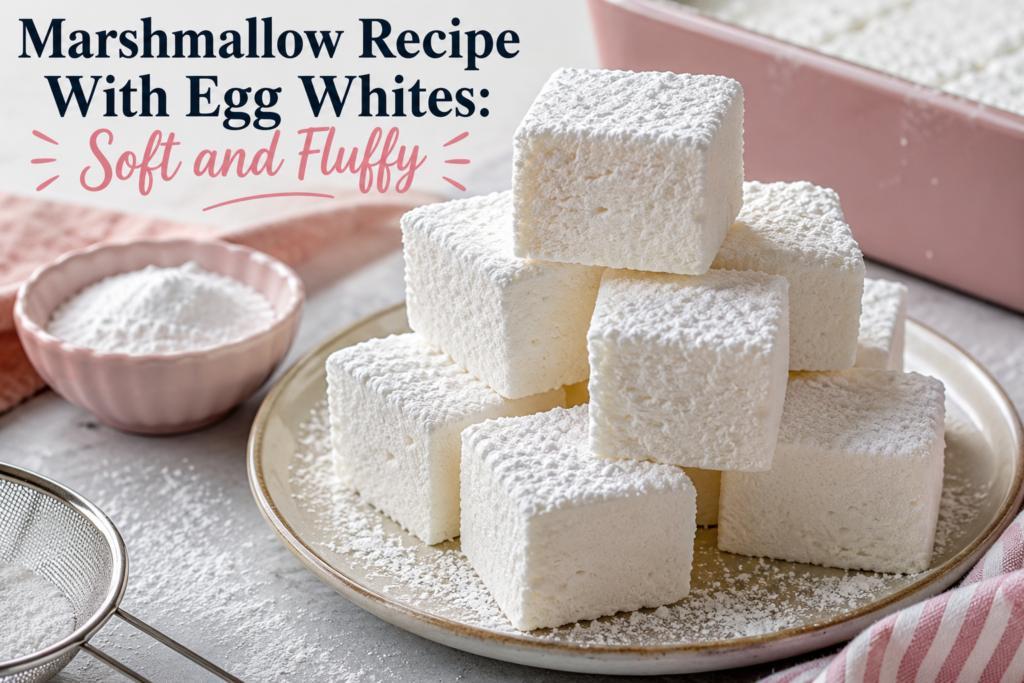
This marshmallow recipe with egg whites creates light, pillowy homemade marshmallows using whipped egg whites, gelatin, vanilla, and hot sugar syrup. Cook the syrup to 240°F, slowly add it to the whipped whites, and beat until the mixture becomes thick and glossy.
Egg whites make these marshmallows lighter than gelatin-only versions, while gelatin gives them enough structure to set and cut into neat squares.
Why Use Egg Whites in Marshmallows?
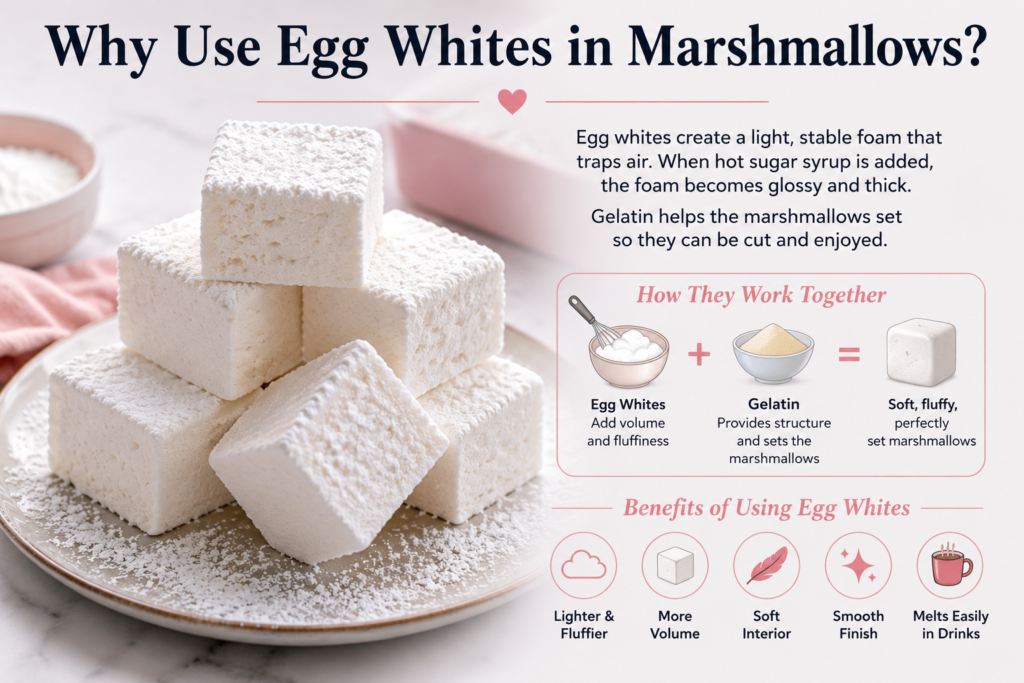
Egg whites trap tiny air bubbles as they are whipped. When hot sugar syrup is added, the foam becomes stable, glossy, and much thicker.
Gelatin supports the foam as it cools, producing marshmallows that are soft but firm enough to cut. Together, the two ingredients create:
- A fluffy, cloud-like texture
- More volume
- A softer interior
- A smooth surface
- Quick melting in hot drinks
This method is sometimes called a French-style marshmallow technique because it combines gelatin with an Italian-meringue-style egg foam.
What Ingredients Do You Need?
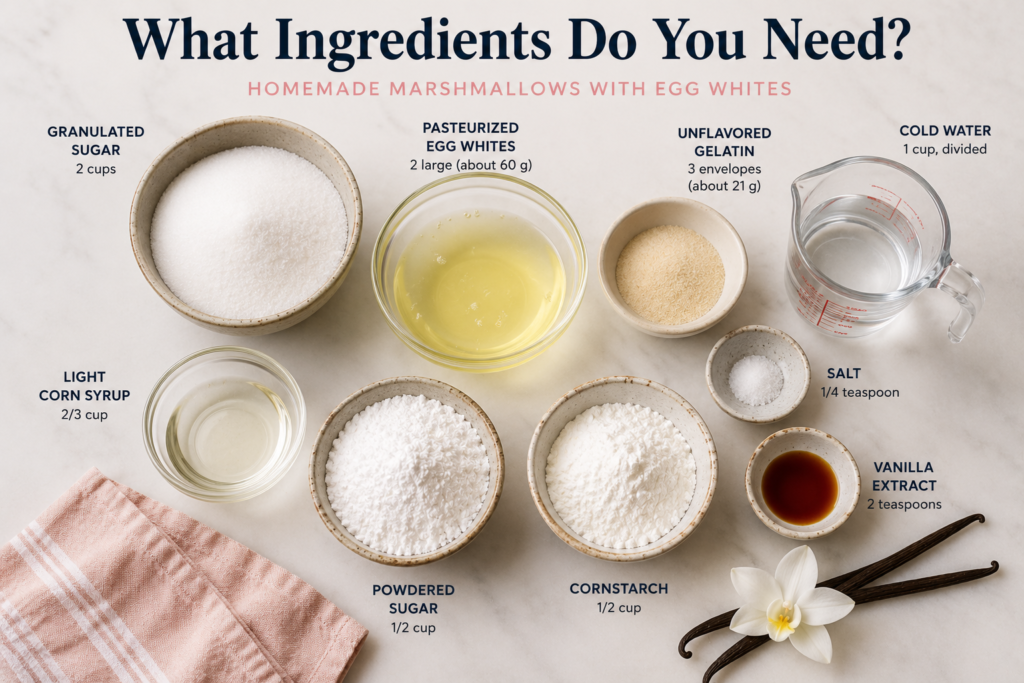
Pasteurized egg whites
Use two large pasteurized egg whites, about 60 grams. Pasteurized carton egg whites can also work when the package says they are suitable for whipping.
Unflavored gelatin
Three envelopes of powdered gelatin help the marshmallows hold their shape. Bloom the gelatin in cold water before adding it to the hot syrup.
Granulated sugar
Regular white sugar provides sweetness, structure, and the classic white appearance.
Light corn syrup
Corn syrup helps prevent sugar crystals and keeps the texture smooth. Glucose syrup can be used instead.
Vanilla and salt
Vanilla adds the traditional marshmallow flavor, while a small amount of salt balances the sweetness.
Powdered sugar and cornstarch
A mixture of powdered sugar and cornstarch prevents the marshmallows from sticking to the pan, knife, and each other.
What Equipment Do You Need?
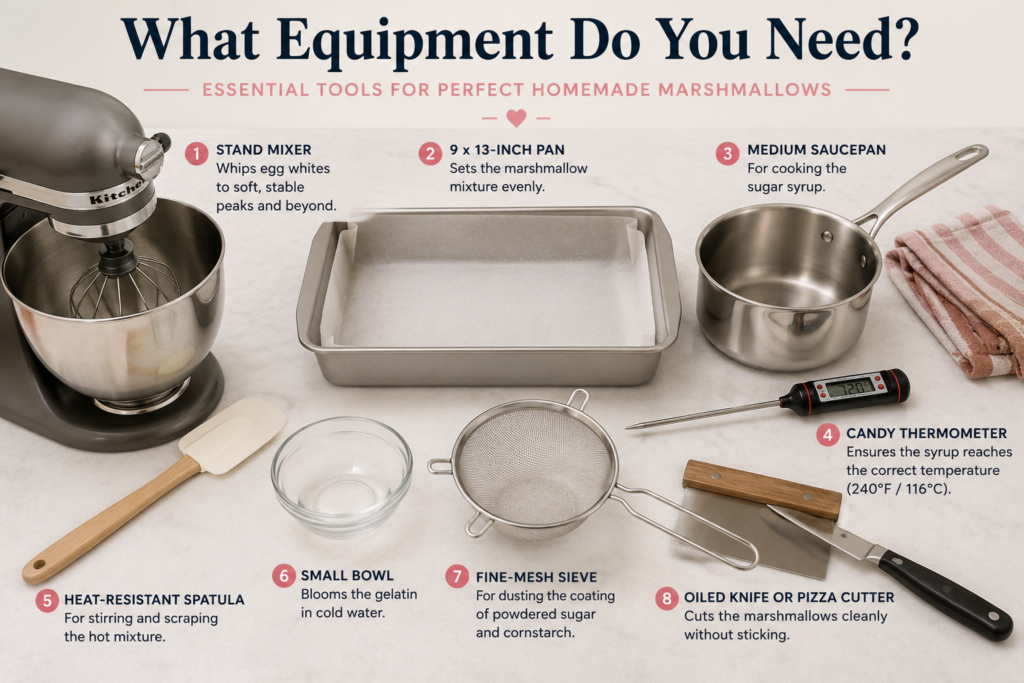
A stand mixer is strongly recommended because the marshmallow mixture becomes thick and difficult to beat.
You will also need:
- A 9 × 13-inch baking pan
- A medium saucepan
- A candy thermometer
- A heat-resistant spatula
- Parchment paper
- A fine-mesh sieve
- An oiled knife or pizza cutter
Prepare the pan and measure all ingredients before cooking the syrup. Once the syrup reaches the correct temperature, the recipe moves quickly.
How Do You Make Marshmallows With Egg Whites?
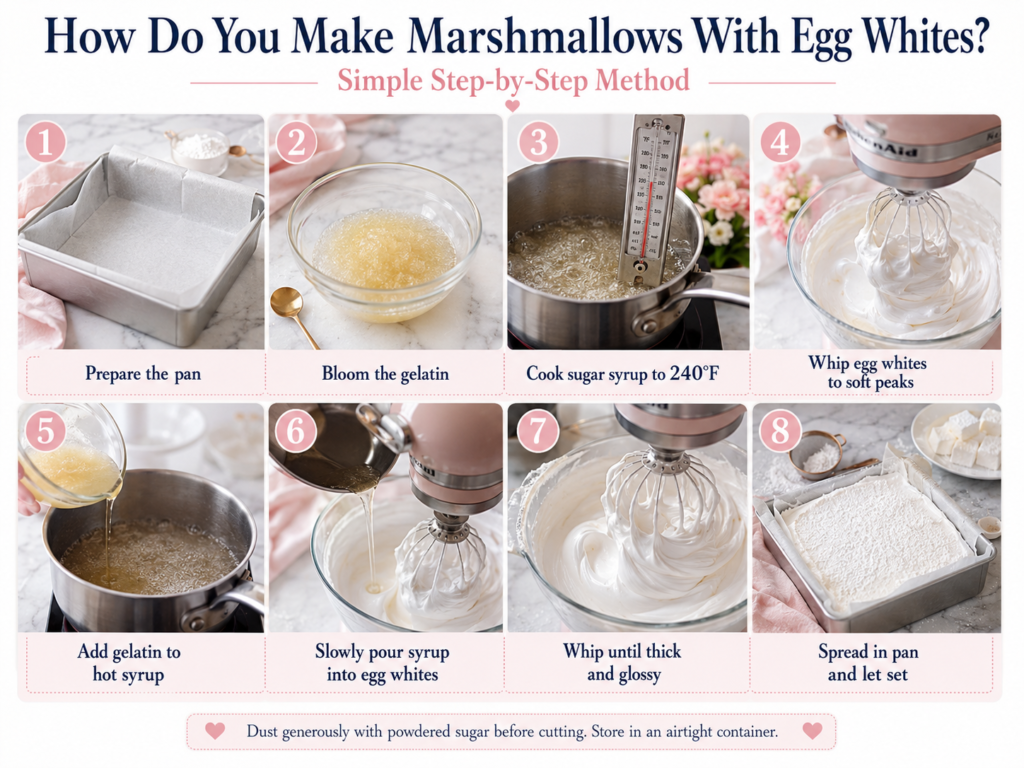
1. Prepare the pan
Lightly grease a 9 × 13-inch pan and line it with parchment paper.
Combine ½ cup powdered sugar with ½ cup cornstarch. Dust the pan generously and reserve the remaining coating.
2. Bloom the gelatin
Pour ½ cup cold water into a small bowl. Sprinkle the gelatin evenly over the surface and leave it for 10 minutes.
The gelatin should absorb the water and become thick.
3. Cook the sugar syrup
Combine the sugar, corn syrup, remaining ½ cup water, and salt in a saucepan.
Heat gently until the sugar dissolves. Once the mixture begins boiling, stop stirring and cook until it reaches 240°F or 116°C.
4. Whip the egg whites
When the syrup reaches about 225°F, begin whipping the pasteurized egg whites at medium speed.
Stop when they form soft peaks. The tips should curve slightly instead of standing stiff and dry.
5. Add the gelatin
Remove the syrup from the heat at 240°F. Carefully stir in the bloomed gelatin until completely dissolved.
The syrup may bubble briefly, so use a deep enough saucepan.
6. Combine the syrup and egg whites
Turn the mixer to low speed. Pour the syrup slowly down the inside edge of the bowl.
Do not pour it directly onto the moving whisk because the hot syrup may splash or harden into sugar strands.
7. Whip until thick
Increase the mixer to medium-high speed and whip for 8–10 minutes.
The marshmallow should become bright white, glossy, and several times larger in volume. Add the vanilla during the final minute.
8. Spread and set
Immediately scrape the mixture into the prepared pan and smooth the surface with a lightly oiled spatula.
Dust the top with more powdered sugar mixture and leave it uncovered at room temperature for at least six hours or overnight.
How Do You Know the Mixture Is Ready?
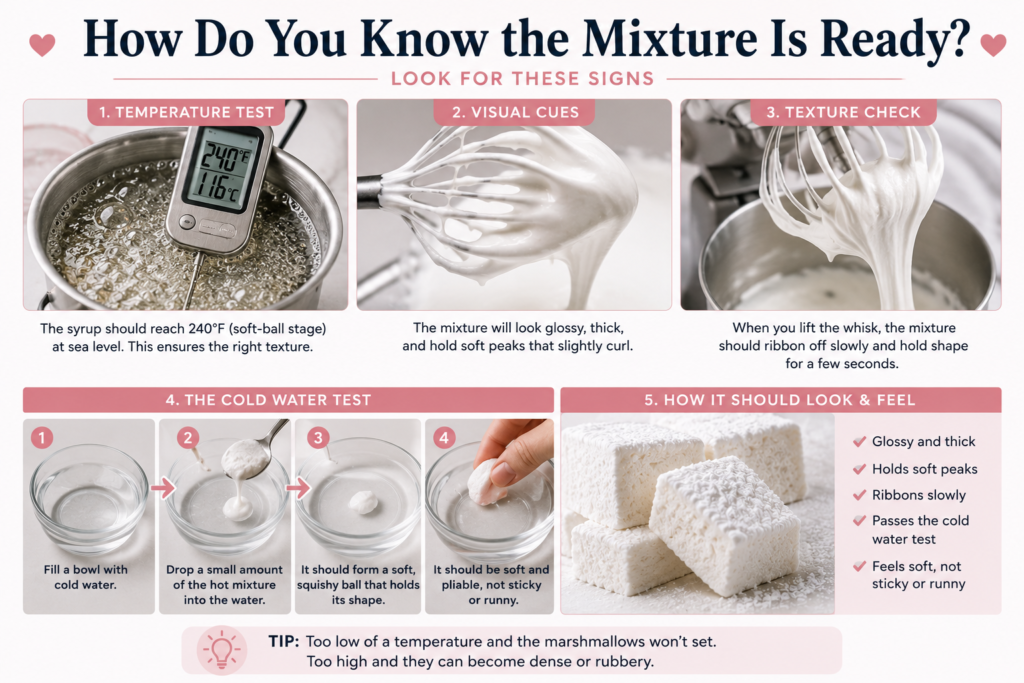
The marshmallow mixture is ready when it looks glossy, thick, and bright white.
Use these visual signs:
| Check | Correct result |
|---|---|
| Volume | About three times larger |
| Texture | Thick and smooth |
| Whisk trail | Remains visible briefly |
| Consistency | Falls in slow ribbons |
| Bowl temperature | Warm, not hot |
| Pan behavior | Spreads slowly |
Underwhipped marshmallow may remain wet or loose. Overwhipped marshmallow can become difficult to spread.
Use the visual texture rather than relying only on the mixing time.
Can You Use Carton Egg Whites?
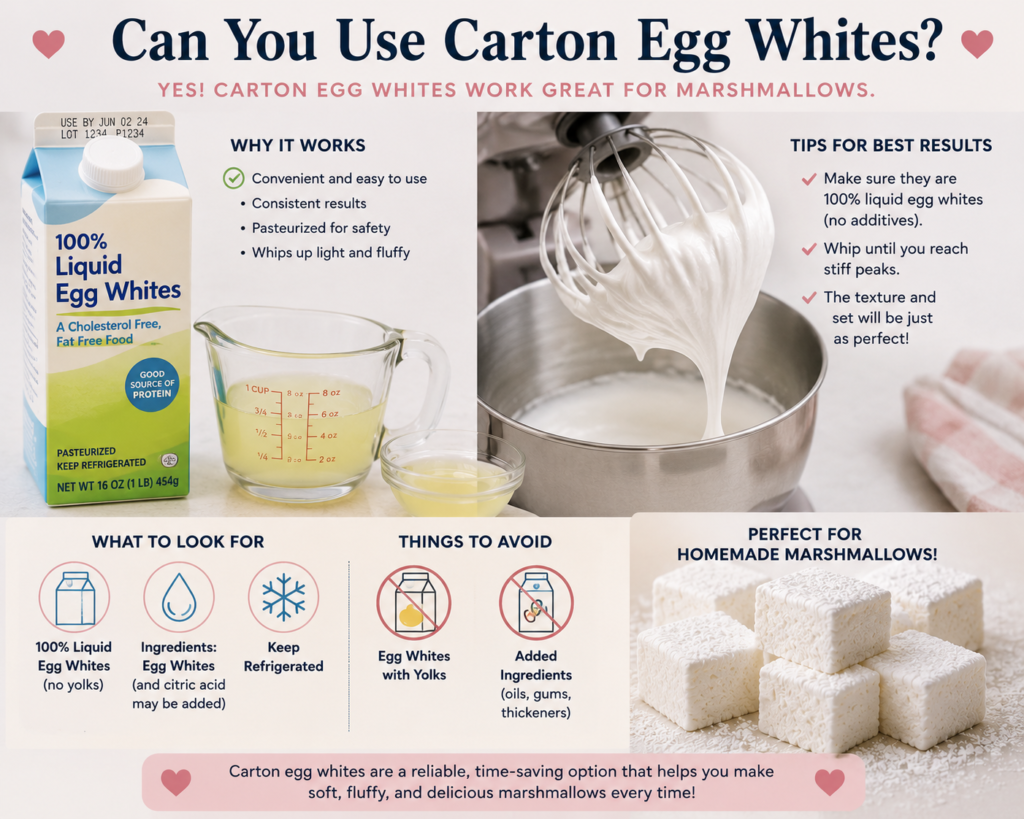
Yes, but carton egg whites do not all whip equally well.
Check the package for wording such as “suitable for whipping” or “suitable for meringue.” Some brands contain additives that can reduce volume.
For better results:
- Measure 60 grams accurately.
- Use room-temperature whites.
- Keep the bowl completely grease-free.
- Begin whipping at medium speed.
- Avoid products containing egg yolk.
Pasteurized shell egg whites usually provide the most predictable texture.
Why Are Homemade Marshmallows Sticky or Dense?
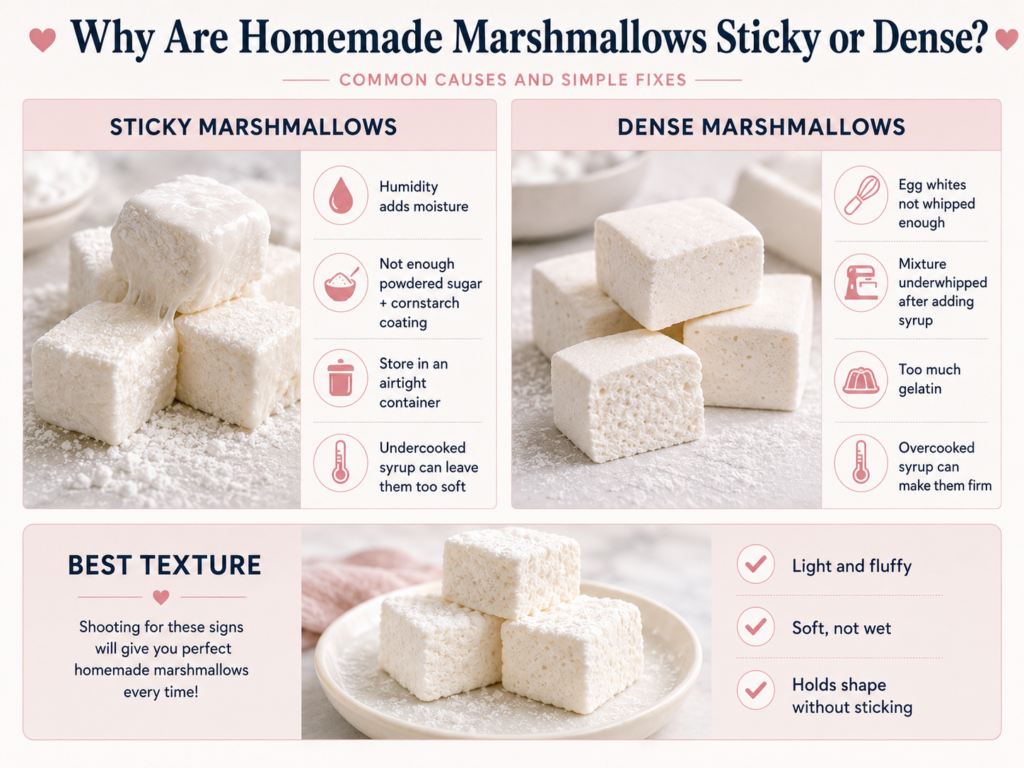
Sticky marshmallows
Humidity is the most common cause. Sugar absorbs moisture from the air, making the surface wet and sticky.
Coat every cut side well and store the marshmallows in an airtight container.
Marshmallows that stay too soft
The syrup may not have reached 240°F, the gelatin may have been measured incorrectly, or too much water may have been added.
Check the accuracy of your thermometer before the next batch.
Dense marshmallows
The egg whites may not have whipped properly, or the finished mixture may not have been beaten long enough.
Use a clean mixer bowl and whip until the mixture has clearly increased in volume.
Rubbery marshmallows
Too much gelatin can create a firm, rubbery texture. Marshmallows may also feel dense when made in a pan that is too small.
Crystallized sugar
Sugar crystals can form when the boiling syrup is stirred or when dry sugar remains around the edge of the saucepan.
Stop stirring once the syrup begins boiling.
Can You Add Other Flavors?
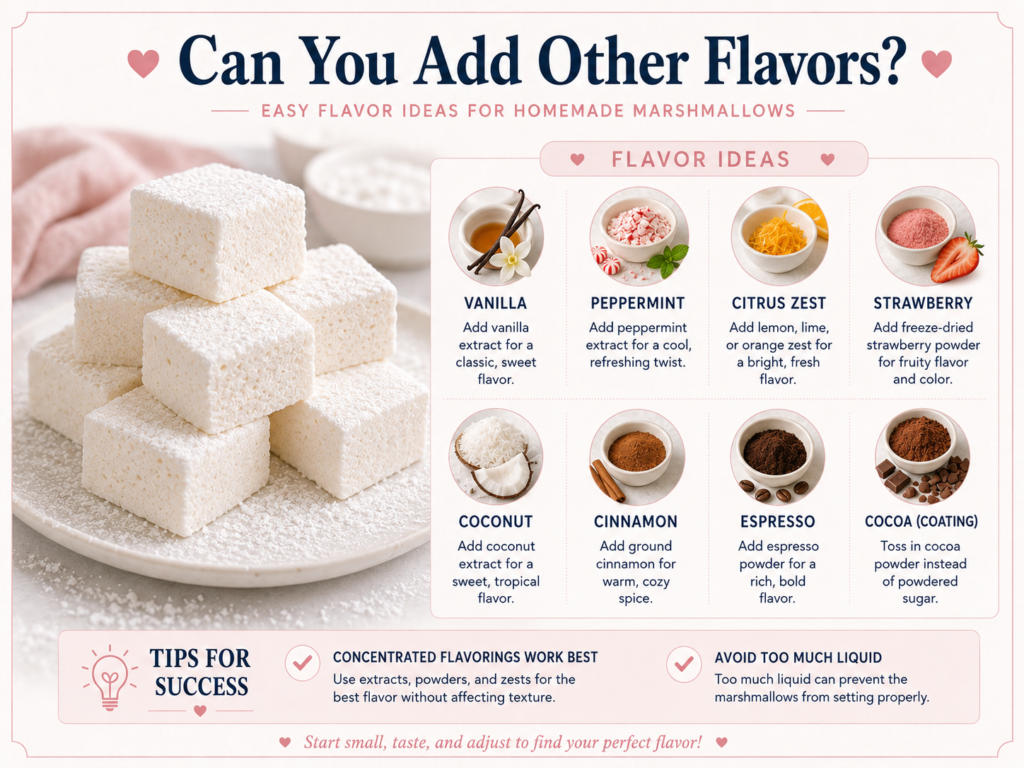
Vanilla is the easiest option, but the recipe can be adapted with concentrated flavorings.
Try:
- Peppermint extract
- Lemon or orange zest
- Freeze-dried strawberry powder
- Espresso powder
- Coconut extract
- Cinnamon
- Cocoa powder in the coating
Avoid adding large amounts of juice or fruit purée. Extra liquid can weaken the gelatin structure and prevent the marshmallows from setting.
How Do You Cut and Store Marshmallows?
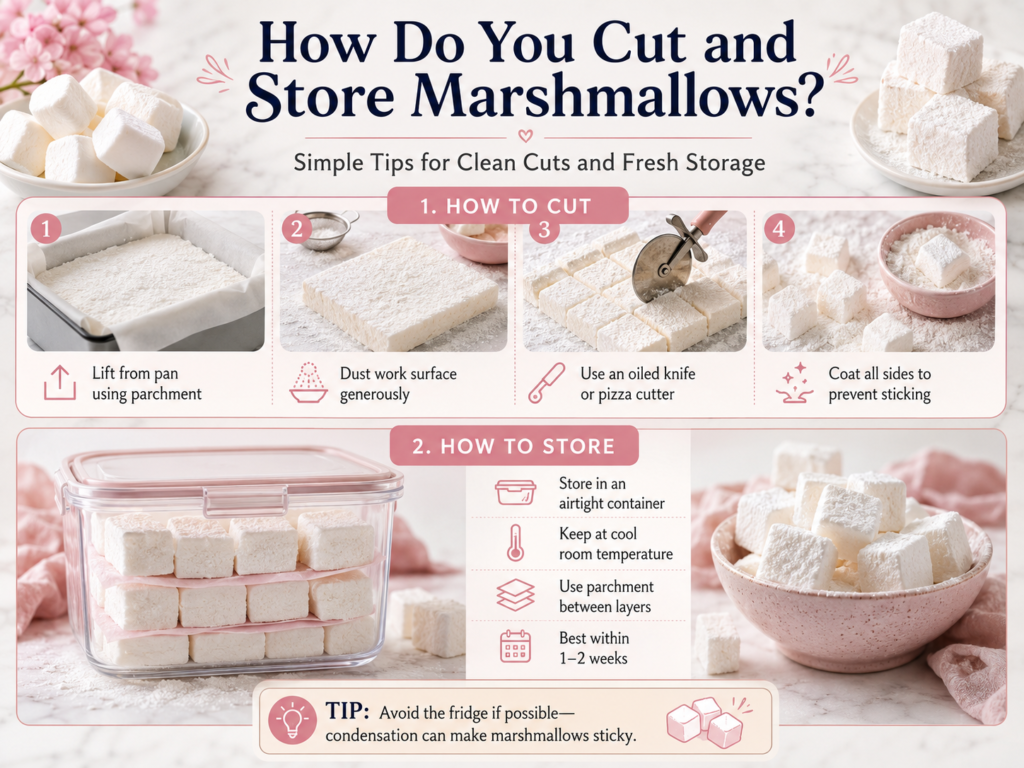
Lift the set marshmallow slab from the pan using the parchment paper.
Place it on a surface dusted with powdered sugar and cornstarch. Cut it into 24 squares using an oiled knife, scissors, or pizza cutter.
Coat every cut side before storing.
Keep the marshmallows in an airtight container at cool room temperature for one to two weeks. Place parchment between the layers and keep the container away from heat and moisture.
Refrigeration is unnecessary and may cause condensation.
Are Egg White Marshmallows Safe?
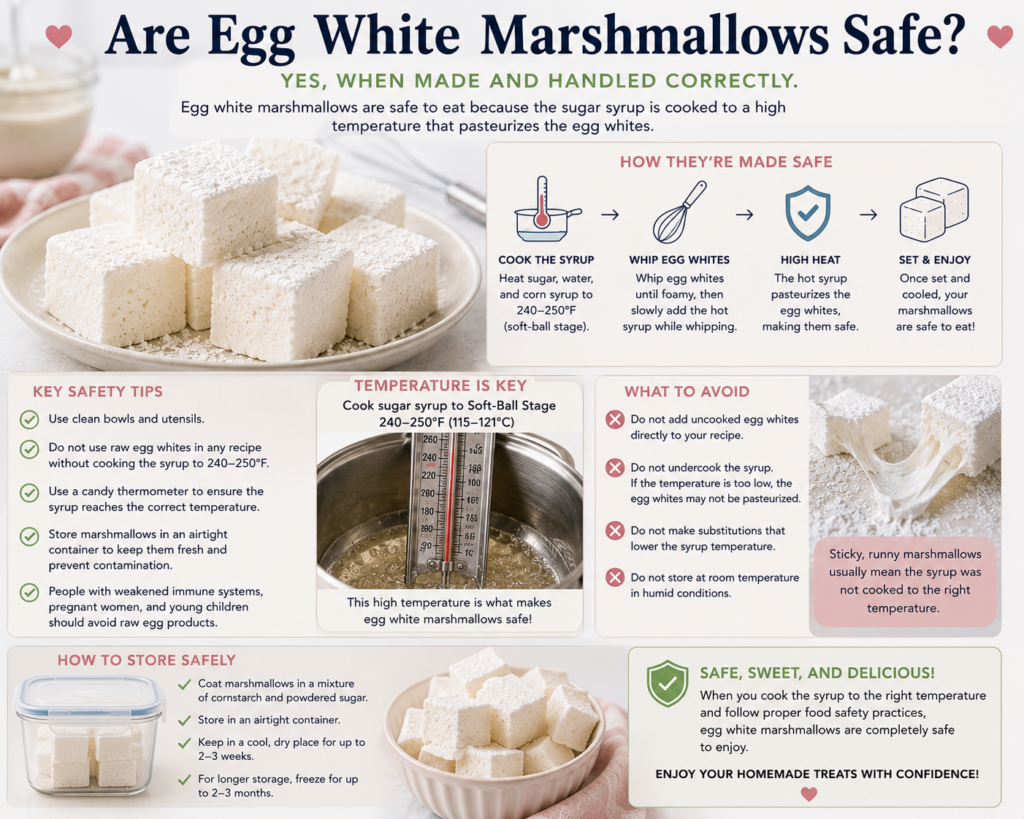
Use pasteurized egg whites because the whites are not cooked separately before being whipped.
Although hot sugar syrup warms the egg whites, it may not heat every part of the mixture evenly enough to replace pasteurization.
Pasteurized whites are especially important when serving children, pregnant people, older adults, or anyone with a weakened immune system.
Recipe details
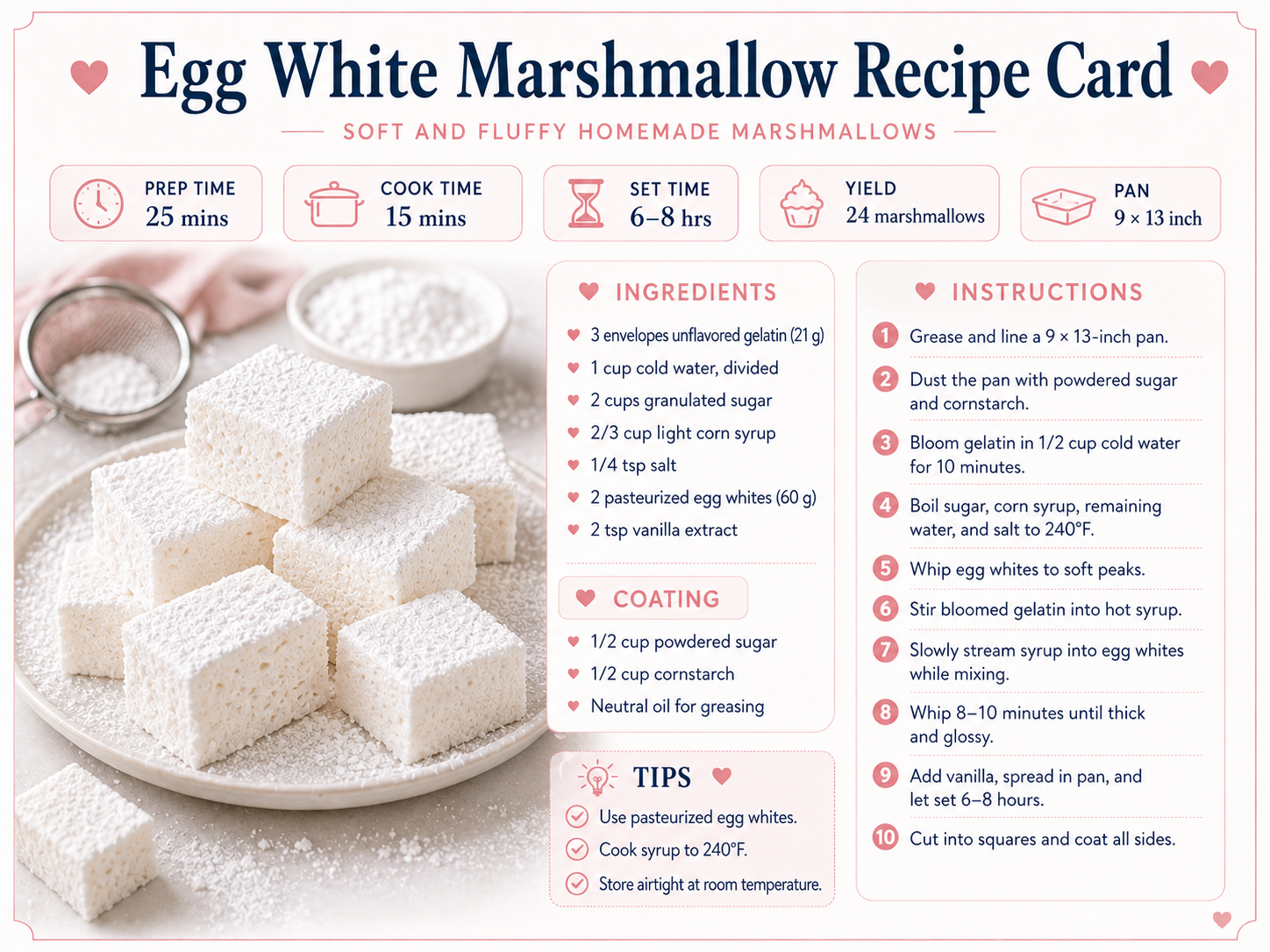
- Prep time: 25 minutes
- Cook time: 15 minutes
- Setting time: 6–8 hours
- Yield: 24 marshmallows
- Pan: 9 × 13 inches
Ingredients
Marshmallows
- 3 envelopes unflavored powdered gelatin, about 21 grams
- 1 cup cold water, divided
- 2 cups granulated sugar
- ⅔ cup light corn syrup
- ¼ teaspoon salt
- 2 large pasteurized egg whites, about 60 grams
- 2 teaspoons vanilla extract
Coating
- ½ cup powdered sugar
- ½ cup cornstarch
- Neutral oil for greasing
Instructions
- Grease and line a 9 × 13-inch pan.
- Mix the powdered sugar and cornstarch, then dust the pan.
- Bloom the gelatin in ½ cup cold water for 10 minutes.
- Combine the sugar, corn syrup, remaining water, and salt in a saucepan.
- Boil without stirring until the syrup reaches 240°F.
- Whip the egg whites to soft peaks.
- Remove the syrup from the heat and dissolve the gelatin in it.
- Slowly stream the syrup into the egg whites while mixing on low.
- Whip on medium-high for 8–10 minutes.
- Add vanilla during the final minute.
- Spread the mixture immediately into the pan.
- Dust the top and allow it to set for 6–8 hours.
- Cut into squares and coat all sides.
Soft & Fluffy Marshmallow Recipe With Egg Whites
Ingredients
Method
- Lightly grease a 9 × 13-inch baking pan and line it with parchment paper.
- Combine the powdered sugar and cornstarch. Dust the prepared pan generously with some of the mixture and reserve the rest for coating the marshmallows.
- Pour 1/2 cup cold water into a small bowl. Sprinkle the gelatin evenly over the water and let it bloom for 10 minutes until thickened.
- Add the granulated sugar, light corn syrup, remaining 1/2 cup water, and salt to a medium saucepan.
- Heat gently until the sugar dissolves. Once the mixture begins boiling, stop stirring and continue cooking until the syrup reaches 240°F (116°C).
- When the syrup reaches about 225°F, begin whipping the pasteurized egg whites on medium speed until soft peaks form.
- Remove the sugar syrup from the heat once it reaches 240°F. Carefully stir in the bloomed gelatin until completely dissolved.
- Turn the mixer to low speed and slowly pour the hot syrup down the inside edge of the mixing bowl while the egg whites continue mixing.
- Increase the mixer speed to medium-high and whip for 8–10 minutes, or until the marshmallow mixture becomes thick, glossy, bright white, and greatly increased in volume.
- Add the vanilla extract during the final minute of whipping and mix until evenly incorporated.
- Immediately scrape the marshmallow mixture into the prepared pan and spread it evenly using a lightly oiled spatula.
- Dust the top generously with the remaining powdered sugar and cornstarch mixture.
- Leave the marshmallows uncovered at room temperature for 6–8 hours, or overnight, until completely set.
- Lift the marshmallow slab from the pan using the parchment paper. Cut into 24 squares with a lightly oiled knife or pizza cutter.
- Coat every cut side of the marshmallows with the remaining powdered sugar and cornstarch mixture before serving or storing.
Notes
Frequently Asked Questions
Do all marshmallows contain egg whites?
No. Many marshmallows use only gelatin, sugar, and syrup. Egg whites are added to some recipes for a lighter, more aerated texture.
Can marshmallows be made without gelatin?
Egg whites alone usually create marshmallow cream rather than firm squares. A setting ingredient is needed for cuttable marshmallows.
Can you make marshmallows without corn syrup?
Glucose syrup can replace corn syrup. A sugar-only version is possible but is more likely to crystallize.
Do you need a candy thermometer?
A thermometer gives the most reliable result. The sugar syrup must reach approximately 240°F for the marshmallows to set correctly.
How long do marshmallows need to set?
Allow at least six hours at room temperature. Overnight setting usually produces cleaner cuts.
Can you toast homemade marshmallows?
Yes. Toast them over gentle heat and rotate continuously because homemade marshmallows can melt faster than commercial ones.
Why are my marshmallows melting?
The syrup may have been undercooked, too little gelatin may have been used, or the room may be too warm and humid.
Are egg white marshmallows vegetarian?
No. Standard gelatin is made from animal collagen, so the recipe is not vegetarian.
This marshmallow recipe with egg whites creates light, pillowy homemade marshmallows using whipped egg whites, gelatin, vanilla, and hot sugar syrup. Cook the syrup to 240°F, slowly add it to the whipped whites, and beat until the mixture becomes thick and glossy.
Egg whites make these marshmallows lighter than gelatin-only versions, while gelatin gives them enough structure to set and cut into neat squares.

I’m Tahira Ramzan, an experienced recipe creator and the founder of EggWhiteRecipes.com. I specialize in simple, practical egg white recipes made with everyday ingredients. My goal is to share easy-to-follow recipes, helpful cooking tips, and reliable methods that make home cooking easier and more enjoyable.